
Northside Fort Worth flatwork
Concrete Commandos Fort Worth: Concrete Company Serving Fort Worth, TX
Driveways, patios, pool decks, walks and repairs for homes on clay soil, from the Northside to Keller. Call or send a few photos and we will come measure.
Serving Fort Worth, Haltom City, Saginaw, Lake Worth, River Oaks, North Richland Hills and Keller, Texas
2606 Chestnut Ave, Fort Worth, TX 76164
What We Pour in Fort Worth
Six kinds of residential flatwork. Open one to see how we plan it for North Texas conditions.
Concrete Driveways
Tear-outs, widenings and new pours, plus help sorting out the city approach.
Concrete Patios
Backyard slabs laid out for grilling, dining and shade, pitched away from the house.
Stamped Concrete
Brick, flagstone, slate or plank textures with color and sealer.
Pool Decks
Cooler, grippy surrounds that drain away from the water.
Concrete Repair
Cracks, sunken panels and flaking surfaces, diagnosed before they are fixed.
Walkways & Sidewalks
Front walks, steps and city sidewalk panels with even footing.
Built for Clay, Heat and the Occasional Ice Storm
What lies under a Fort Worth slab shapes how it should be built.
Tarrant County ground is not uniform. The surface geology mapped by the Dallas Paleontological Society runs from the Woodbine and Eagle Ford to formations such as the Fort Worth Limestone and Denton Clay, and the Eagle Ford weathers into the "black gumbo" soil whose bentonite can swell or shrink by as much as seven inches with moisture[1]. A slab poured without regard for that movement tends to crack, tip or lift.
- Moisture control: grading, downspouts and slope decide whether the soil under a slab stays steady.
- Base and steel: soft soil comes out, the base is compacted, and reinforcement ties the slab together.
- Joints with a plan: joints set before the pour guide shrinkage cracks into straight lines[2].
Weather is the other half. Dallas/Fort Worth normals average about 20 days a year at 100 degrees or hotter and about 29 nights at or below freezing[3]. Heat speeds setting and drying, which can cause early cracks without careful curing[[CIP12]], and freezing combined with deicers causes surface scaling[[CIP2]]. We plan pour times and give winter care advice for both. Read more about our shop or browse finish ideas.
Permits: Your Lot vs. the Parkway
Which pieces of a job the city cares about.
The City of Fort Worth draws a line at the property line. Flatwork on your own lot does not need a permit, but new or repaired drive approaches and sidewalks need parkway permits pulled by a bonded contractor[4]. The city's parkway standards also limit approach widths, from 11 to 15 feet for a one car garage up to a 28 foot maximum for three cars or more[5].
Cities next door write their own rules. Read the page for yours before you plan: Haltom City (permits for slabs over 10 by 10 feet), Saginaw, Lake Worth, River Oaks, North Richland Hills and Keller. Many newer subdivisions also have an HOA that reviews driveways and patios, so ask for its form early.
From Phone Call to Finished Slab
Five stages, with no surprises at the end.
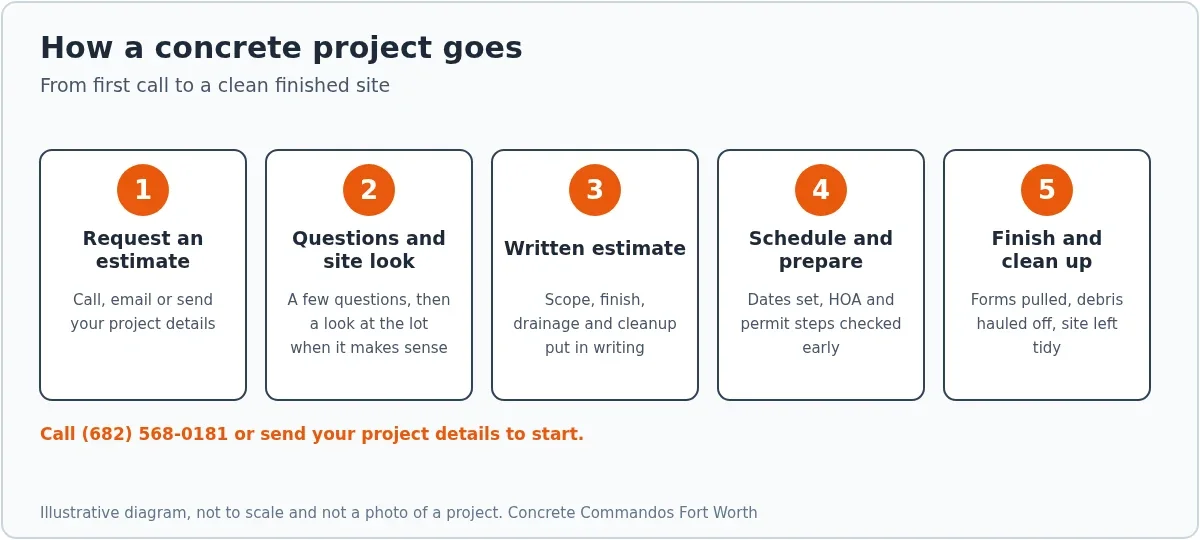
- First contact: call or send the request form with a few photos.
- Site visit: we measure, check drainage and access, and note anything in the parkway.
- Itemized quote: thickness, steel, joints, finish and permit items, in writing.
- Scheduling: pour dates set around weather, HOA approval and any city permit.
- Pour, cure and clean: forms out, debris hauled away and care instructions handed over.
What Moves the Price
No posted per-foot rates, just the factors your quote will list.
Two driveways with the same square footage can be priced far apart. These are the items that move a Fort Worth quote:
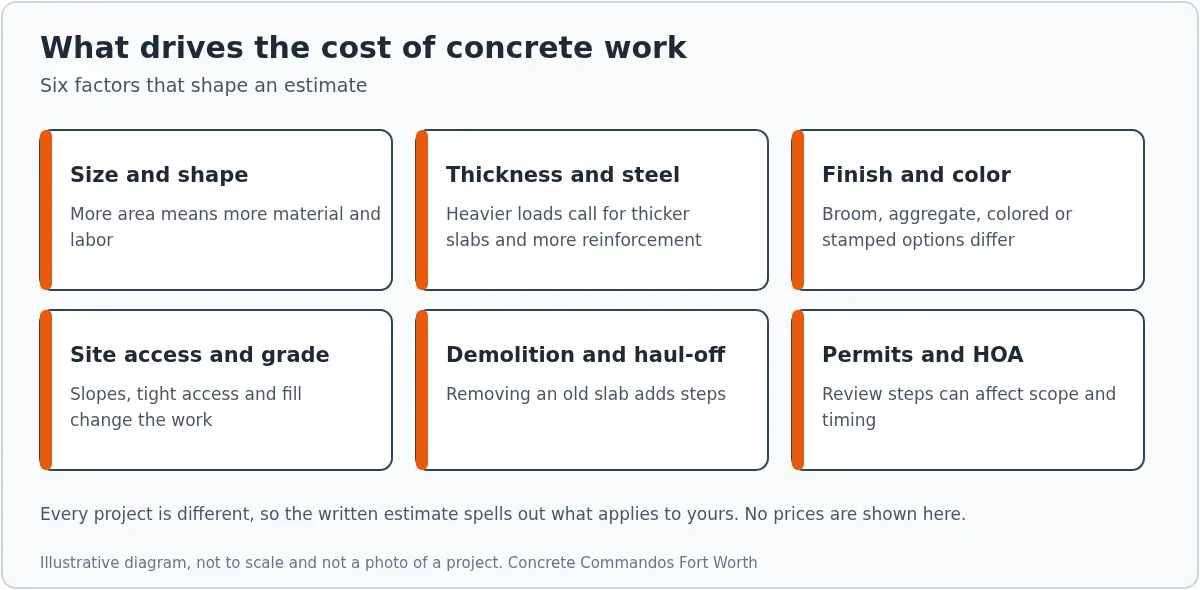
- Break-out: removing and hauling off an old slab adds labor and disposal.
- Base repair: soft or washed-out soil has to be replaced before pouring.
- Finish: broom is the baseline; aggregate, color and stamping add cost.
- Parkway work: approaches and city sidewalks bring a permit and inspections.
- Access: tight side yards and alleys can mean pumping or wheelbarrows.
Call (682) 568-0181 or use the form to get a quote built from your actual lot.
Cities We Cover
From Chestnut Avenue on the Northside to the suburbs north and east. Each city page lists its permit office notes.
Find Our Northside Shop
2606 Chestnut Ave, Fort Worth, TX 76164. Directions. Please call before visiting.
Fort Worth Concrete Questions
Short answers to what homeowners here ask us most.
Which cities do you cover besides Fort Worth?
From our shop at 2606 Chestnut Ave, Fort Worth, TX 76164 we cover Haltom City, Saginaw, Lake Worth, River Oaks, North Richland Hills and Keller. Nearby and not listed? Call and ask.
Does Fort Worth require a permit for a new driveway?
The city says flatwork on your own lot does not need a permit. The drive approach and public sidewalk are in the parkway, and new or repaired approaches and sidewalks need parkway permits pulled by a bonded contractor.
Why does concrete crack so often in Tarrant County?
Much of the area sits on clay that swells when wet and shrinks when dry, including Eagle Ford clays known locally as black gumbo. Good drainage, a solid base, steel and planned joints keep that movement in check.
When is the best season to pour in Fort Worth?
Concrete can be poured most of the year. In summer we start early and cure carefully because heat speeds setting and evaporation. In winter we watch the forecast for freezes.
Should I put salt on my concrete when it ices?
Try not to, especially in the first winter. Deicing chemicals make freeze and thaw scaling worse. Sand gives traction without harming the surface.
What is included in your written quote?
Size, thickness, reinforcement, joints, finish, demolition and haul-off, any parkway permit items and cleanup, so you can compare quotes line by line.
Ready for a Quote?
Planning a driveway, patio or repair in Fort Worth or nearby? Phone (682) 568-0181 or use the estimate form at the top of the page.